Saturday, September 4, 2010

Rachel's Tomb


Of the many disturbing aspects of the occupation, I am perhaps most disturbed by the attempt by Israeli policies and practices to excise history.

There is the practice, most often successful, to take land in expropriation as though the people who’ve been living there for years either are not important or didn’t even exist.

There is the practice of rewriting history, as though there hadn’t been a plan to cleanse whole tracts of land of the people, families and villages which had been living, farming and existing for generations.

And then, there is the practice of pretending as though another religion (or, other religions) don’t justifiable exist. Policies are in place to make it difficult for Christians from Bethlehem to come to the city of Jerusalem, specifically the Old City, during the holy days of Holy Week for worship and family gatherings. There is the policy that restrict the number of people who can receive permits to go from the Bethlehem side to the Jerusalem side of the Separation Barrier for worship on Fridays at al-Aqsa mosque in the Old City of Jerusalem.

However, after weeks of living in Bethlehem, with one of the ugliest “facts on the ground”, I think the most egregious practice of excising history is the de jure practice which is turning into de facto belief that Rachel, one of the wives of Jacob (who was renamed Israel), is not an ancestor to all of the children of Abraham.

Once upon a time, Jacob, the grandson of Abraham whose oldest son was Ishmael and whose second son was Isaac, was owned many flock of sheep and goats and was married to two sisters. Between the sisters and their handmaids, Jacob had 11 sons and one daughter.

The beloved wife, Rachel, was pregnant and giving birth to the 13th child and died in childbirth. The boy lived to be Benjamin, but Rachel was buried there alongside the path, for these were nomadic people. The village they happened to be by was Bethlehem. After Jacob buried Rachel, he set up a pillar at her grave – a place that has been known as Rachel’s Tomb ever since (Genesis 35:18-20).

The people of Bethlehem cared for Rachel’s Tomb for many years -- as Canaanites, as Israelites, as Jews, under Roman occupation, as Christians, as Muslims, under Ottoman occupation, under Jordanian occupation, as Palestinians. For the people in Bethlehem, regardless of their religious affiliation, regarded Rachel as one of their own. She is understood to be one of their ancestors; she is a matriarch in the faith.

For years, the grave, though cared for, was exposed to the weather. A tomb was built over it. Then, when many in the area were Muslim, a mosque enclosed Rachel’s Tomb to both protect her grave and honor her memory. Around Rachel’s Tomb, a Muslim burial ground was established. To this day, this is one of the cemeteries in town that is used as a final resting place for Bethlehemites who are Muslim.
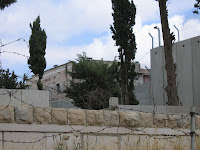
Yet, Rachel’s Tomb is cut off from Bethlehem and from her people by the Separation Barrier (in the form of a 27 foot wall). The wall creates a de facto border line between Bethlehem (part of the West Bank) and the expanded municipality of Jerusalem, which now includes Rachel’s Tomb and an access road (which used to be part of the Jerusalem-Hebron road). While in other parts of Bethlehem, the wall roughly (though by no means exactly) delineates the urban area of town, it snakes a kilometer or more into the city to excise the tomb area. In the process, residents in the area have experienced a dramatic change in their economic opportunities (the wall has blocked the Jerusalem-Hebron road in three places), and ease of access to homes (more than one house is now down an alley, where before they were on a main road).

Most importantly, however, the fact of this barrier has removed the opportunity for faithful Christians and Muslims to honor and pay respect to one of the Mothers in the Faith.

Monday, August 9, 2010

Presentation, presentation, presentation


I returned to the US from Palestine on June 15, 2010. The last month was busy with activity and writing (yes, I do plan to sit down and write about all of those things on this blog in the next month or two). When I got back, I spent some time visiting with family, and then began a presentation tour with 15 "shows" in 15 different locations across the United States. After 6000 miles, 14 states, and 20 days of traveling, I ended up back in the Pacific Northwest.

I gave presentations in churches and in homes to people who were well versed in the situation and to folks for whom this was mostly new information. Over and over again, I people were surprised, shocked and dismayed when they learned of the injustice, the oppression, and the violence done to Palestinians whose stories I shared. Many were also unaware of the long history of occupation in the region (not just Israel occupying the land, but before them the Jordanians, the British and the Ottomans).

Many thanks to the people who hosted the presentations (and me) and who came to hear the stories and see the pictures!

Wednesday, May 19, 2010

Dreaming of a stronger community

Seven Palestinian women from a village in the West Bank gathered together for their weekly English class. Afterwards, they spoke about their ideas and dreams for strengthening and improving their village and their life together. Khadija articulated the basic and powerful idea that these women had when she exclaimed, “I can do simple things and encourage others to do the same.”

Khadija happened to be talking about garbage at that moment; her simple action would be to take the wrapper of whatever snack food she’d just bought at the store and choose to throw the wrapper in a garbage can, even if that meant carrying the wrapper to her home. Layla echoed those sentiments and exhorted the families of the village to take care of their garbage by coming together to create a dedicated place for the garbage and then take it al there.

Mariam reminded all of us gathered that it’s not only up to the municipalities or village councils to solve problems; the people in an area can, and should, also work together to come up with and implement solutions. For example, in her part of the village, a very steep dirt road would turn muddy and slick during the winter months of rain. The road always became dangerous during the winter months and people would fall. However, the residents along the street got together and had the road paved. While the pitch of the hill remains the same, the asphalt has minimized the danger and the mess of the road.

The ideas continued to flow about creating a community library, an after school program and a community playground. The women, feeling empowered by the encouragement they receive from their women’s center convener Jihan and the interactions with international women who come to visit them, were interrupting each other in their excitement to share their ideas and plans for their village: home and community.

Yet, the women also know limitations. Not only are there naysayers about their ideas about garbage, parks and libraries, they know first hand the restrictions of a traditional village structure. Even though more and more girls and women are continuing their education into the universities, and, on the whole, there are fewer restrictions for women to travel into the city of Bethlehem, the patriarchal system of father, brothers and/or husband giving permission for the women to express their ideas publicly, visit their neighbors, or work to effect change is a firm reality for these creative and articulate women.

The ideas and possibilities are still present and they still ring out in the room where the women’s group meets for learning and conversation, regardless of limitations or naysayers. As Amani declared, “we are used to the restrictions, but we have learned to stand despite them, and to be strong!” The dreams for a stronger and healthier community are still alive and well in the hearts, minds and lives of these women.

Creative resistance to the occupation and the occupiers

Near Rachel's Tomb in Bethlehem (and therefore, near the Wall), the Sumud story house, run by Pax Christi International, gathers together Palestinian women and children for stories, conversation, encouragement, spiritual growth and laughter. Ranja, the manager and host of the house, welcomes you into the main room which is decorated as though it were the inside of a traditional bedouin tent.

Lining the tent room are sign boards with stories of creative resistance to the occupation of Palestine and to the occupiers from Israel. Here is one of those stories:

As happened more than once during the time of the (first) Intifada, Israeli soldiers were beating up a man in a crowded street. From all sides people rushed to the scene. Suddenly a woman with a baby came forward to the man and shouted: “Why is it always you who makes problems and goes to demonstrations! I am fed up! Take this baby of yours! I don’t want to see you ever again.” She laid the baby in the hands of the man, and ran away. The soldiers left the scene in confusion. When quiet came, the man returned the baby to the woman. They had never seen each other before. Described by Mounir Fasheh (1998).

You are invited to follow this link to read other stories from Sumud story house: http://www.aeicenter.org/sumud/stories_from_Palestine/Moral_stories.htm

Tuesday, May 18, 2010

Irony

"A country is not just what it does -- it is what it tolerates." (Kurt Tucholsky, German essayist of Jewish origin)

The real irony of this quote is that it is written on one of the walls of Yad Vashem, the Holocaust museum in Jerusalem. While Tucholsky was writing these words, the people of Germany of the early 20th century was tolerating less and less tolerance by her government and leaders.

I also found it ironic that the central and main hall of the Yad Vashem museum complex was constructed out of concrete walls and that the path taken by the museum goers was through various cuts in those walls which are of the same width as the concrete walls of the separation Wall that is being built around Palestine (and mostly on Palestinian land). The ones who experienced terrible intolerance and imprisonment are now exacting the same intolerance and imprisonment on another people.

Monday, May 10, 2010

God's "Sumud"

Psalm 62:5-12; 1 Timothy 2:1-6; John 16:23-33

When, if ever, are we alone?

As I've been with Palestinians in their homes, as they wait in the checkpoint lines, as they go to school or work and as we talk in conversations, a theme that often shows up is sumud, an Arabic word that means (approximately) "steadfastness", or "perseverance". The people who use it generally mean that they are steadfast and patient; they persevere as they wait for the occupation to end somehow, someday.

Today, our psalm and even our Gospel text speak of sumud. Except, in these verses, the sumud is God's: "Steadfast love belongs to you, O Lord" (Ps. 62:12a); "Yet I am not alone because the Father is with me." (John 16:32b)

The world may shift and change, the mountains may shake (even if it just feels like it, as one woman said about the arrival of the army at 2:00 am at her house), the seas may roar, the soldiers may come in the middle of the night, the bulldozers may come to take down a house or a grove of trees, the settlers may burn field , one may feel abandoned and alone in the midst of the occupation, but God's steadfast love is always with us, because "steadfast love belongs to you, O Lord."

Sometimes we forget to turn to God, to trust God or to ask God for help, but as Jesus reminds all of his disciples, his Abba is always there and listening. Jesus instructs the followers to ask (as they haven't done before) and their joy will be complete.

I believe our joy will be complete because we are turning toward and trusting God, and being in relationship with God. That will be the source and the fulfillment of our joy.

Do we, can we, remember sumud? God's sumud is the promise made and the beginning of creation and the promise made throughout the people's lives in the stories of scripture. God's sumud was made incarnate in the life and life-giving love of Jesus, the Christ. God's sumud was promised to you in your baptism and is renewed in the Supper, in your cabbage soup and in your daily life. God's sumud is renewed in you even on, especially on, the days when you feel most alone and abandoned.

I know that it can be difficult to remember this. I know that the darkness of loneliness and despair can work to block out God's steadfastness and God's promise. I know.

It may even feel, at times, that you've gone too far away or that you may think your wrongs are too egregious for God to contemplate forgiving. You may feel that God has left you -- and for good reasons. After all, if any one of us were waiting for friends or relying upon them and they were way too late or negligent of us, they we would leave and walk away -- usually in a huff. Far too often we think of God in our own image; so if we would leave, then surely God would as well, right?

But, steadfast love belongs to you, O Lord.

And, upon God rests my redemption, my honor, my refuge and my hope because God's promise of sumud is not contingent upon anything we say or do (or don't say or do). God's sumud is there as the promise of steadfast love and grace for you and you and you and you. Amen

Saturday, May 8, 2010

Life next to a settlement


Mahmoud has lived on this land for years and before him, his father and grandfather (and maybe more) have lived in that spot. The view from the hillside is beautiful -- your eye skims over the valley and up to the next hillside which is covered with houses, with terraces and with groves of olive trees.

If you look closer, you'll see a pile of rubble in the foreground of your scan. As you turn on the knoll of the hill, you'll see another pile of rubble. Finally, as you turn 180 degrees from the view of the groves of trees on the far hillside, you'll see the fence, buildings and towers that are an Israeli settlement.

Mahmoud's land abuts the land that the settlers have claimed and built upon. For the most part, they have been good neighbors with Mahmoud (and he counts the mayor of the settlement as one of his friends), but there has been trouble spanning the past 25 years regarding the land.

First, one of the houses on the property was demolished by the Israeli government (the reason given? He didn't have a permit -- a thing that is close to impossible to get nowadays and wasn't necessary in the past), then a second house was demolished (explaining the two piles of rubble). Several times, Mahmoud's sheep have been poisoned. The most recent of these incidents was 2 years ago when 19 sheep were poisoned to death and another 20 fetuses aborted because of the same poison. Lest you doubt the story, Mahmoud has documentation of all three incidents -- two from the International Committee of the Red Cross and the other from a veterinarian.

Next, invaders came onto Mahmoud's property and into his house (a very simple two room home that houses a large family). The invaders roused Mahmoud from his sleep (he was enjoying the night air by sleeping on the patio) and took him aside while the entered the house, damaged the television and radio, then cut the telephone line.

And, in growing desperation to make life so distasteful and awful for Mahmoud and his family that they would rather leave than stay, one night three men (two who spoke only Hebrew and one who also spoke Arabic) came to the house, took Mahmoud out far away from the house and offered him a suitcase full of money (American dollars that probably totaled in the millions) in exchange for him abandoning the house and his claim to the land. This offer has been made several times, and each time Mahmoud refuses to make the deal. The men who come at night have also offered to send Mahmoud and his family to the United States where they would have "a better life."

But, Mahmoud has refused to leave. His life is here -- on the land, with the crops, trees and amongst the flock of sheep. He continues to farm (wheat, olives, sheep) and to live, to feast and to welcome guests, to trust and to be friends with his neighbors of the settlement. His needs are quite simple and he sees no reason, incentive, nor legal justification to leave his land.

This is his home. These are his roots. This is where he will live and where his sons and daughters-in-law will raise their families. Mahmoud's resistance is heard loud and clear when he says, "I just want to build a home for my family. I don't want anything fancy. I just want to build something simple on my land."

Arabic lesson


Marhaba! Kiif halkum?

(Your response is "hamdu-lillah! Maabsuttiin")

Good day! How are all y'all?

"Praise God! We're all fine"

Arabic is one of those mind boggling languages that has multiple layers to learn: the speaking part (including masculine and feminine forms of every noun, pronoun, verb, etc.), and the written part. Then, you have to decide if you want to go further and try to learn the classical language (instead of the colloquial version). In classical Arabic, there are 12 possible endings for every noun, verb, pronoun, etc. (instead of just 8).

But, if you've learned some of the basics, including
la = no
aywa (or na'am) = yes
shukran = thank you
afwan = you're welcome
ahlan wa sahlan = Welcome! (to which you respond ahlan wa sahlan fiik!)
wa salaam aleikum = hello (to which you respond aleikum wa salaam)
ma is-salaame = goodbye

If you've learned these, you've covered a lot of ground. Of course, you cannot have a real conversation, but at least you can say hello and be friendly! Then tricky bit is, if you sound too good with these phrases, then your conversation partner thinks that you can actually speak Arabic and might launch into some other topic about which you CANNOT converse.

Then, you just look at them dumbly with your mouth hanging open. Try it, it works.

It's at that point that I usually think "WHY didn't I study Arabic before coming here like I intended to?!?!?!?"

Sermon's missing

No sermon this week. Sorry. I wrote one, but it wasn't very good.

And, I've been away and not posting for awhile. I hope to catch up in the next few days.....

Saturday, May 1, 2010

Boys in jail, part 2

The family awoke with a start from the banging on the door. They didn't know what to do, so they huddled together and tried to ignore the shouts, the smell of the tear gas seeping through the cracks around the door and windows and the crashing sound at the door. After a few minutes, the door to the roof burst open and several soldiers from the Israeli army came down the stairs into the house.

The family was herded out of the house in their nightclothes into the courtyard at 1am where they were held with the red point of light of the laser sights of the machine guns aimed at them. They were all asked to produce their identification cards because the army had come to find Fadi, one of the sons of the household. Once they identified him, questioned him about his older brother (who's in the Palestinian police) and his father (who works at a settlement), they forced Fadi to strip to check that he wasn't armed and dangerous. After hastily dressing again, Fadi was put into one of the jeeps to be taken away.

Fadi has asthma and didn't have the chance to bring any of his medication. As the soldiers were hauling him away, his mother was screaming at them about his asthma and begging the soldiers to help him. They said that they would, but when she finally had the chance to visit him in prison, he said that he never had any treatment. Rather, Fadi reported to his mother (and uncle who also came to visit) that the soldiers mistreated him and kept him in isolation. He was very angry, very sad and frightened.

What is the crime this young man of 16 is to have done? The reason given was "throwing stones". His family thinks that someone turned in his name (often, under interrogation, the boys are pressured into giving the names of their friends. Some do so, just to make the questioning stop). Fadi's father doubt that his son would throw stones at soldiers since he's afraid of them and of what they can do.

The family supposes that the real reason that Fadi was arrested is because he took part in a non-violent demonstration in Hebron several months ago. Soldiers usually take pictures of the people participating in the demonstration as evidence that they are there. Since Fadi was at this demonstration and may have had his picture taken, the army may be retaliating for his presence. But, nobody really knows.

The imprisonment is not just for Fadi anymore, though. His younger siblings are fearful every night. They do not want to go to bed in their own beds; they want only to sleep with their parents. The expenses of the lawyer are more than this family can afford; they hope that friends and neighbors will help them. Fadi's father, who works at a nearby Israeli settlement as a construction worker for 100 NIS (about $27) a day, has not been allow to returned to work since Fadi was arrested. Thus far, he'd lost 2 weeks worth of work and he had no idea when (or if) he'd been allowed to return. Of course, since his work permit expired on May 1st, there's a very good chance that he won't return to that job at all (the Israeli employer must apply for the work permit for the employee).

As of the day of our interview, Fadi had not had his case heard in court (the trial date was delayed three times). If things go as they usually do, he will end up with 6 -7 months in prison with a 5000 NIS ($1350) fine.

For a boy on the edge of manhood, the price for being the age, gender and nationality that he is is so high, not just for him, but for his family and community.

Boys in jail

"I thought that it was an earthquake," said Mariam, a mother of one of the boys arrested in one of the villages surrounding Bethlehem. The night that the army came for her son, the barrage of noise created by the army made her think that a natural disaster was occurring. Except this disaster was not natural; it's a reality of life under military occupation.

This past week, we talked with three families who experienced night incursions and who had sons taken into custody by the army. These were just three families of the seven in this village who have had sons arrested in the past two weeks. Of the eight boys (two sons from one family), only one has been released; the rest await a court date.

Lo'y is 16. He's a studious kid who is smart and who wants to go to the university to study engineering. He's been in 11th grade this year and was getting ready to take special classes this summer to get ready for his last year in school which includes the difficult exams one has to take in order to have a chance for University.

On Thursday morning at 2am, four army jeeps came to Lo'y's house, and the soldiers surrounded the house. They banged on the front door and fired off sound bombs (or "stun grenades": the noise is so loud that it stuns you). Then, they fired tear gas canisters at the house breaking the window of the bedroom of the younger brother of Lo'y and damaging the stone facing and some of the doors in an effort to evacuate the family (since the family wasn't getting out of the house fast enough for the army). The tear gas in the house was so noxious, that they had to stay outside until morning to allow the tear gas to dissipate.

Once they were all out of the house, the soldiers grabbed Lo'y, handcuffed and blindfolded him and hit him in the back of his head with the butt end of a machine gun. The soldiers demanded that Lo'y give them the address of one of his friends, but he refused, earning himself another beating.

The charges against this young man? Throwing stones at army jeeps. Lo'y's mother and father both asserted that Lo'y is too afraid of soldiers and their repercussions. "He's a serious student!" Yet, because of this charge, he's been taken to one of four Israeli military jails to be held for at least 18 days - the same day as his court date - before he can even see a lawyer, much less his family. The boy who dreams of university courses will likely end up missing too many days of school (because of this arrest) at the end of this year to be able to advance to the next grade. Depending on the sentence that will be handed down in a trial that will not permit evidence from the defense, a sentence that could be up to 6 months with a 5000 NIS ($1,345) fine, Lo'y will also miss the beginning of next year's classes.

And his family? In a family of four sons and three daughters, the next to the last child is the first to be arrested, but the whole family feels the anguish, the anger and the frustration of the arrest. Lo'y's mother said it best, "we are all exiled."

Bread

This was a feast of bread and more bread (the high stack of bread has za'atar on it (a spice mixture of thyme and sesame seed).
Another day, we had bread made for us as we visited a family in a small village. I got to go with the daughter-in-law of the house into the stone oven where she formed the bread and laid it on the hot coals to cook. The finished product is, by far, the best bread I've ever eaten and it's unavailable in stores. You have to have sources!


Monday, April 26, 2010

Some geography basics, politically speaking

This is a picture of our particular area: Bethlehem. The upper left hand corner is part of Israel. Hopefully you can discern the "Green line" (it's a dotted green line) that goes from about the center of the top at an angle down towards the middle of the left hand side. This is the 1948 UN Armistice line for the West Bank.

The darker yellow areas of the map are the urban areas that are part of "Area A" (Oslo Peace Accords of 1995); the slightly lighter yellow color areas (hard to distinguish) are part of "Area C". We don't have much Area B in our area of Palestine.

The dark pink color indicates the established Israeli settlements; the lighter pink color shows areas that built up areas around Israeli settlements (for example, where construction is taking place, where agriculture is happening, location of outposts). The important thing to note is that anything pink (no matter what shade) is off limits to Palestinians.

You can also see lines squiggling around the map: the dark red ones show where the separation barrier (around here, we call it "the wall", since we mostly see the 8 meter high monstrosity) already exists; the light red is where the separation barrier is being constructed; the black is planned construction of the barrier. The grey lines are roads.

Finally, you may be able to discern dots. The red dots with the "x" are the checkpoints; the black dots are on the "settler's roads" and are tunnels or underpasses.

Please note:
  • The red line of the separation barrier (and the sections under construction or planned) are deeply within the area that was designated as part of the West Bank in 1948;
  • There are several villages which are isolated from the city of Bethlehem (the little yellow areas that are in a sea of grey -- which means that the Palestinians in the villages are not allowed to go in the grey areas, except with permission);
  • In addition to the established Israeli settlements (some of which have been around since 1967, YEARS before the building of the separation barrier, but built at the time the territory was transferred from Jordanian military occupation to Israeli military occupation), there are planned settlements. For the most part, the planned settlements are actually extensions of the existing ones.
  • It's hard to tell from this map, but Bethlehem is almost completely encircled by "Israeli only" areas. The pink settlement areas are easy to discern, as is the separation barrier. What's harder to see is that on the east and southern sides of the city, there's an "Israeli only" road. At this point, Palestinians are allowed to drive on parts of it. But, road construction is underway to build roads for the Palestinians to use instead. Two notes about that: guess whose land is used to build the road (without financial compensation, of course)?, and why have two completely separate sets of roads that essentially parallel each other? Ne'er the twain shall meet! The Palestinian set of roads goes under the Israeli roads when the two cross. Of course the Palestinian roads are below! If they were above, then those "terrorists" could throw stones on the Israeli cars. (I'm not kidding. This is how the settlers and policy makers think.)
There's much more to say, and you may have questions. Please post them below, but I'll also be writing again (and probably posting the map again for reference) about the political geography.

BTW, this is a United Nations - Office on the Coordination of Humanitarian Affairs (UN-OCHA) map of the occupied Palestinian territories (oPt). They have great maps. So does ARIJ (Applied Research Institute - Jerusalem).

Sunday, April 25, 2010

Good Shepherd Sunday

Psalm 23 (NRSV)
The Lord is my shepherd, I shall not want.
He makes me to lie down in green pastures;
he leads me beside still waters;
he restores my soul.
He leads me in right paths for his name's sake.

Even though I walk through the darkest valley,
I fear no evil;
for you are with me;
your rod and your staff--
they comfort me.

You prepare a table before
in the presence of my enemies;
you anoint my head with oil;
my cup overflows.
Surely goodness and mercy shall follow me
all the days of my life,
and I shall dwell in the house of the Lord
my whole life long.

Living in a place where you may encounter sheep grazing in the fields right next to your house or where a flock might be trotting down the street to be let into another field by their Bedu shepherd sure gives a new depth of meaning to this psalm.

Even with that new visual, I'm not sure I have a sermon in me today [I wrote this sermon last Sunday, but it's apropos for today as our lectionary calendar has us read this psalm this week]. I'm exhausted, on the edge and lacking resiliency. But, if I'm at this state after only 5 weeks in this area, can I even begin to fathom what life is like for people who have to live in this every day with no escape (or desire to leave the land that is home). As for me and my well-being, I would leave if I had the opportunity.

And, honestly, true confession time!, I avoid preaching on this text if I can. I don't really like it; it feels so overused that it has become trite in my ears.

But, here it is. God (and the creators of the lectionary cycle) have put it before me to hear, wrestle with, be spoken to and dwell deeply in the words, rhythms, images and grace that are this psalm. These particular phrases resonate deeply within me this time:
--I walk through the darkest valley, yet fear no evil
--[God] prepare[s] a table before me in the presence of my enemies.
--Surely goodness and mercy shall follow me all the days of my life

Early on in our time as a team in Bethlehem, we decided that we needed to be honest with each about the work we were engaging in and our limitations. We all 'fessed up at least one thing (that was expected of us as a team) that we did NOT want to do. Mine was "going to demonstrations". I've never liked demonstrations or protests. It may be in part because I don't want to be too public about my politics or ideas (says the preacher lady!). It may be because there's an element of danger in it (I like to be a rule follower and most of the time demonstrations are technically illegal, at least here in Palestine). And, I'm sure that a large part of this is that I don't want to be caught in any sort of cross-fire -- even if it's just words being thrown.

Whatever the reason, I don't like demonstrations.

But, they are a part of what we do each week. As a team, we are to participate in at least one demonstration each week (actually, that's now three. AHHHH!).

Talk about the darkest valley.

I've wondered sometimes if there is an entrenched cultural difference (made deeper in the past 43 years): if I'd lived under occupation for my whole life, would I be used to it? If I was raised under occupation and if there had always been less of my life that I had oversight for, would it be easier for me that the Israelis had tremendous control over me?

Then, there's the image of God preparing a table for me in the presence of my enemies. What?!?

My time here as radically shifted how I hear this portion of the text now: when one has enemies, real enemies, not just ones from petty griefs, who are wanting to destroy you (by bullets, policies, prisons, threats and/or prejudice), this image of God preparing a table for you in the presence of those enemies is incomprehensible.

It scares me.

It humbles me.

It even angers me. I do not want to eat with my enemies.

But, surely, God's mercy and goodness are with me all the days of my life. God's mercy invites me to the table to sit with and break bread with my enemies, to look beyond their bullets, policies, prisons, threats and prejudice. God's goodness brings light and hope into those darkest valleys of fear, even the fear that rises in me when I consider the danger that may come from standing in solidarity with someone.

Surely goodness and mercy shall follow me all the days of my life. For you, O Lord, have walked in the darkest valleys and have eaten with those who are your bitterest enemies. And, through it all, you are compassion, goodness and mercy for all who need it.

Amen

Saturday, April 24, 2010

Here comes the Wall, like it or not!

In a nearby community called Beit Jala (a hilly little town!), a portion of the separation barrier (between Israel and Palestine) is being built. In many places around Palestine, the barrier approximates the 1948 UN "Green Line" that demarcates the West Bank (it's usually built on Palestinian land inside the Green Line, but at least it's pretty close). There are, however, many places where the barrier makes deep cuts and excises great swaths of land out of Palestine, making the land, in effect, Israeli.

And, then, there are places where the Wall follows the "settlers' roads" (which, depending on the place and time, Palestinians are not allowed to drive on, even though, again, the roads are in the West Bank). One of those places where the Wall is along a settler road is in Beit Jala. The road actually goes through two or three tunnels (I honestly don't know as foreigners are not allowed on this particular road) underneath the town of Beit Jala. Because of the topography and the layout of the town, there are places where there are houses just above the road.

For "security" purposes, then, the military decided that the Wall (including an extra angled barrier atop the 8 meter high wall) needed to line the road so that the resident Palestinians (or anyone else who wanted to cause problems) couldn't stand by their houses and throw rocks on the cars going by down below.

The problem is, you might have figured out, that there are houses and yards and gardens and trees right where the wall is planned to be put it to protect the road.

Last Thursday (a busy day for both the military, and those responding to their egregious actions), a house lost its front yard, the children's play structure, part of their patio, and several of the generations-old olive trees that provided a portion of their income. In order to continue building the Wall. To protect a road from imagined danger and threat (danger that hasn't been realized in this place).

Because this is an occupation and one group has more power than the other.

Language

The words that we use are an important indication of what we think and believe. They also shape how we act and how we treat people.

In my own work and study (prior to coming to Palestine and Israel), I have been reading and talking about Compassionate Communication (a.k.a.: non-violent communication). There are many books, pamphlets, workshops, websites to learn about compassionate communication (I've listed a few at the end of the post), but there is a common theme through them all: we are, all of us, human.

When one uses one's thoughts and words to demonize the other, it is easy to loose compassion for the other and then it is a short slide down into treating the other badly (with abuses of words and actions). One of the central arguments of compassionate communication, then, is to think about (and speak about) all of the people whom you meet (even if you don't really like them) as human beings, and to work to build some sort of relationship with them.

But, I digress a bit from my intended topic....

What words do we use to describe the people in and the reality of this area?

Arabs or Palestinians? Arab is a general term that covers the people of a large geographic area. In the West Bank, people define themselves first as Palestinian. In Israel, which has a small population of people of Palestinian background, the term Arab-Israeli is most often used.

Israeli or Jew? This is a trickier question. Most people who live in Israel are Jewish, but not necessarily "religious" Jews. There are a significant number who are "secular", who consider themselves culturally and maybe even ethnically Jewish, but not necessarily religiously. They would most likely identify themselves as "Israeli." Those who self-identify as "Jewish" tend to be active in expressing their faith as reformed, conservative, orthodox or ultra-orthodox Jews. However, as I talk about or report about interactions between the two groups of people, I almost always use the terms "Palestinian" and "Israeli" (unless the topic is religious, and they I use "Palestinian Christian", "Palestinian Muslim" and "Israeli Jew").

Soldier: An Israeli person who serves in the Israeli Defense Forces. Each man and woman in Israel has a required two year term of service. He or she usually does this service following graduation from high school. Sometimes the soldiers come from other countries (every Jewish person in the world is welcome to come to Israel for a "birthright" tour and/or to immigrate. If one immigrates, one must also serve in the IDF; if one comes on tour, one may choose to serve in the IDF for the two years as well).

Military occupation: the use of military forces and military law to govern another people who live in land that is considered part of the occupying forces' land. Usually, military occupation is a temporary solution during a time of transition from war to peace. Rarely does military occupation last more than 40 years. In fact, one could argue that the only place it's lasted that long is in the West Bank.

West Bank or Palestine? When I am speaking of the occupation or about the Israeli government and military's relationship to the geographic area, I will often say West Bank. When I am speaking about the people who live here and about their life, or when I am conversing with them, I always speak of Palestine. An alternate form of that is "occupied Palestinian territories", or oPt. That is probably the most accurate term (it's also the longest).

Which brings up the question, why "West Bank" when the area is on the eastern side of the region mapped as "Israel"? The name comes from history: following in the 1948 war, the territory was occupied by the Transjordanian military and was labeled the "west bank" of the Jordan river. After 1967, when the Israelis "won back" the territory from the Jordanians (NB: name change of the country now called "Jordan") the name stayed.

Books about Compassionate Communication:
The Search for a Non-Violent Future, Michael Nagler
Non-Violent Communication, Marshall B. Rosenberg

Thursday, April 22, 2010

Facebook response

One of my friends posted an editorial from the Huffington Post (written by Desmond Tutu about divestment in Israel). The comments that followed that post prompted me to write the following. It's a bit of a primer and just barely touches on the major issues. But, for your reading pleasure and as food for thought for the day:

I'm currently living in Palestine for a few months to work with a program that works with and assists Palestinians who are using non-violent forms of resistance to end the occupation.

There have been suicide bombers and rockets from the Palestinian side. This is true (although the majority of this happened during the second intifada 10 years ago).

Statistics show, however, that there have been a greater number of human rights violations against Palestinians by the Israelis than the other way around. The number of Palestinians who are detained without due process is high (the reverse has never happened). There are also a high number of children (ages 12-16) who have been detained for weeks or months (these are not necessarily stone throwing boys, by the way. These are kids who happen to be in the wrong place at the wrong time) without any notification of family.

But, what has been more appalling to me than any of that is the daily grind of humiliation and inhumanity of military occupation which affects
  • economy (the unemployment rate is quite high, esp. in some areas of Palestine and, of course, in Gaza),
  • family life (more than one village is cut off from their social network of family and friends because of the occupation and the separation barrier--often manifest as a 26 foot high concrete wall topped with an electric fence),
  • education (kids who want to and could go to college/university are denied, by the Israeli military, the permits to go),
  • religious expression (for example, Palestinian Christians and Muslims alike are limited in their movement for religious worship. At Easter, Palestinian Christians were denied the right to go to East Jerusalem (which is legally part of Palestine) to worship at the holy sites in the Old City. The Old City was full of faithful people, but they were all from other countries) and
  • many other aspects of life.
In the mean time, there is a policy from the Israeli government and military to expropriate land, which is owned by Palestinians, to continue to expand housing, farming and construction for Israelis. When Palestinians attempt to use legal means to respond (read: attempt to keep their land), the courts often rule against Palestinians, or if the courts rule in favor of the Palestinian family, the military overrules the civil law and imposes military law.

Many Palestinians find themselves caught in a bind and are frustrated. Everywhere they turn, they encounter the reality of someone else (who has guns; every Israeli has the right to carry a gun and believe you me, many of them do) who tries to stop them from just living their daily life of family, work, learning religious expression.

Transportation

Going to the fields,
one way....
....or another.


To market, to market!


Take the service to work,

or the school bus to school


Vote for one:
which do you think would make the better clown car? Seriously, I saw people driving these cars. And, sometimes, there are 5 or 6 people in cars this size!

Garbage, a really stinky problem

Last week, I was part of a series of workshops for women in a village near Bethlehem (I presented a brief overview of Compassionate communication/non-violence as a way of life). At the end of the week, one of the questions asked of the women who participated was: "what's one thing that you learned this week that you'll put into practice in your everyday life?"

Most of the women made general comments ("I think the water system in the village needs to be fixed", "I want there to be peace and for the occupation to end"). While those kinds of comments were made with great passion and hope, they were also quite general.

But Khadija said, "I think there is too much garbage in our village and I want to try to clean it up."

I say, "Go, Khadija!!" I agree with her and have, frankly, been appalled at the amount of garbage everywhere. In Bethlehem (and in all of the Palestinian cities which have services provided by the Palestinian Authority), there are large bins on the streets in which to throw garbage. They're not always emptied in a timely manner, even if they've filled up. Usually, someone will throw a match into the bin then, to burn up the garbage. UGH. Besides the pollution and toxins released into the air, the stench chokes me.

Even the refugee camp, which is run by the UN, has a garbage problem. My friend and housemate Stefan took the photo at the beginning of this post.

Recycling is not even considered as an option. Neither is composting. I cringe every time I throw a plastic bottle, tin can, or piece of paper into the garbage bag. AHHHHHH!

To the left and below are some pictures I took in Jericho earlier this week. The garbage dilemma seems to be exponentially worse there than in Bethlehem. These are all shots taken from the hotel I was staying at. These two that are side by side (just below) were taken from the balcony of the room I was staying in looking straight down and to the left.

The final photo is across a courtyard, as seen from the staircase.


Wednesday, April 14, 2010

Crossing the checkpoint. Or not, as the case may be, part 2

In my previous post, I wrote basic information (and thoughts) about the checkpoint process. About a week ago, I had my own specific and frustrating experience with the main Bethlehem checkpoint (called variously CP 300, Bethlehem CP or Gilo CP)

One afternoon, three of us were going through CP300 to meet with Efrat of Ta’ayush to go then to An Nu’man CP (yet another, very specific and specialized kind of checkpoint that we also monitor). It was 1:15pm and we were already running just a few minutes late. We passed through the first turnstile with no problems. But, then we got stuck in the terminal at the metal detectors. Hannah and Giselher were in one line and I in another. My line was moving at first, theirs was stopped. But, then, my line stopped (there were a lot of people/kids part of groups). I couldn’t decide if I should just jump over into the other line or stay where I was (after all, I was about half-way through my line and the other one wasn’t moving either). I sent Hannah a text message asking about the status of their line; she told me they were stuck too, so I stayed in place.

It seems the metal detector was having mechanical problems (poor girl who was stuck in the detector area!), so they finally closed the booth (after about 20 minutes). We then all moved to the other line (and jostled with each other to get the best place in this long line. Some people jumped in as close to the front as they could (after all, they'd also been waiting in line for a long time, why should they now end up in the back of the line?), others formed a big blob at the end and tried to jockey for a better position.

All told, I was in line for an hour and but I never did make it through. At first I was patient and resigned about it all, but as time went on and the line wasn’t moving, I became more irritated and even angry. Why? I realized later that it was because I was embarrassed to be so late to meet with Efrat; that she was having to wait for us. I felt awful about that. I talked to her once and sent her a couple of text messages, so she knew (and she said, “no worries”), but I was still concerned.


Finally, in great frustration, I left the line and went home (Hannah and Giselher had been through for about 30 minutes by that time); I sent the others on with Efrat to make our visit.

It was a taste of the frustration and annoyance that Palestinians deal with all the time.